
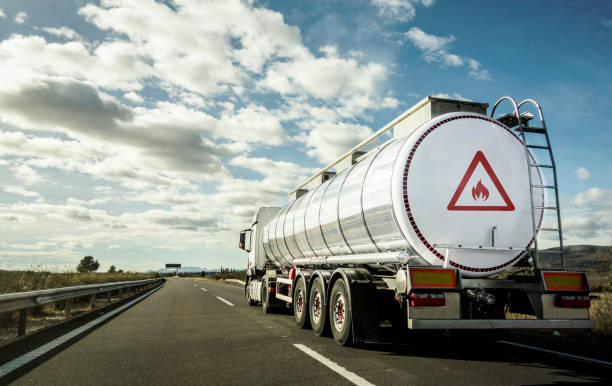
Operating more than 40 multi-compartment tank trucks, 5 barges/vessels, and around 1,560 trips per month, our customer needed a platform capable of managing both road and waterway transportation while supporting the highly specialized requirements of petroleum logistics. Smartlog Transportation Management (STM) was deeply customized to cover order management, dispatching, GPS tracking, mobile apps, actual volume, 15°C converted volume, VCF, product loss, and billing. Across multiple implementation phases, STM has gradually become a centralized operating platform connecting transportation, fleet, fuel, and customer-facing processes.
ABOUT OUR CUSTOMER
Our customer is a provider of specialized logistics and transportation services for the oil & gas sector, transporting products such as A95 gasoline, E5 gasoline, and diesel oil to service stations and between storage facilities.
Its operating network combines owned and outsourced fleets, including more than 40 tank trucks with capacities from 7–25 m³, 5 barges/vessels, and 6 external transport partners. Monthly transport volume is estimated at around 1,560 trips.
OPERATING CONTEXT
Petroleum transportation goes far beyond basic vehicle dispatching. Each trip may require the control of temperature, actual volume, volume converted to 15°C using VCF, and product loss across loading, unloading, and pumping activities.
Before the project, dispatching still relied heavily on manual work. Transport orders were printed or sent by email, proof of delivery was handled through signed documents, while freight reconciliation and fuel reporting were consolidated in Excel. Customers also lacked a real-time channel to track delivery progress and reconcile billing.
KEY CHALLENGES
Fragmented dispatching and limited end-to-end control
Orders, trips, drivers, and customer information were not managed on one centralized platform, making trip creation and dispatching highly dependent on manual processes.
Limited real-time visibility
Operations teams lacked a centralized tool to monitor vehicle locations and actual routes. Customers had to wait for manual statements instead of proactively tracking delivery status and freight charges.
Petroleum-specific processes beyond a standard TMS
Parameters such as temperature, 15°C volume, VCF, and product loss needed to be consistently recorded for each trip. Manual processing increased complexity and the risk of data discrepancies.
SMARTLOG’S APPROACH
Smartlog implemented STM as a highly customized transportation platform for oil & gas logistics, while gradually expanding the scope from road transportation to waterway operations.
Centralized order, dispatch, and trip management
Orders and trips are managed centrally in STM, while transport instructions are sent directly to the driver mobile app. GPS enables real-time monitoring of trip status, vehicle location, and actual routes.
Digitizing petroleum-specific operations
Drivers can record temperature, actual delivered volume, 15°C converted volume, VCF, and product loss directly through the mobile app and STM, replacing fragmented manual calculations.
More transparent billing and fleet management
Customers can directly reconcile shipment volume, revenue, and freight charges on the system. STM also extends into maintenance, inspection, vehicle and driver costs, and fuel reconciliation.
RESULTS
Following implementation:
Dispatching moved from manual processes to centralized management on STM.
Orders and trips can be tracked in real time through GPS.
Customers can reconcile billing directly on the system instead of relying on Excel statements.
15°C volume, VCF, and product loss are recorded directly through the mobile app and STM.
Phase 1 achieved 92% feature implementation, equivalent to 49 of 60 items, at the time of acceptance.
The project was then expanded into waterway transportation, fuel management, and further STM enhancements across multiple phases from 2023 to 2026.
BUSINESS VALUE
This case demonstrates that STM can go far beyond vehicle dispatching and be customized for highly specialized transportation models, particularly liquid bulk, chemical, and petroleum logistics.
By bringing orders, trips, GPS, billing, fuel, and fleet data onto one platform, the customer can reduce reliance on paper-based processes and Excel while creating a more connected data flow between operations and customers.
The phased expansion also shows how STM can evolve as transport modes, operating scale, and management requirements become more complex.
- #smartlog
- #tms
- #transportmanagement
- #transformation
- #oil
- #gas



Comments (0)
No comments yet. Be the first to comment.